
Beinecke MS 408 · state of the research, 17 November 2026
What we know about the Voynich manuscript, and what we still don't
A 15th-century book written in a script nobody has read. We ran hundreds of pre-registered statistical tests on it, each first calibrated on texts where we had hidden the answer ourselves. This page shows what came out: what the text is, what is ruled out, and what could still settle the question. No decipherment is claimed anywhere.

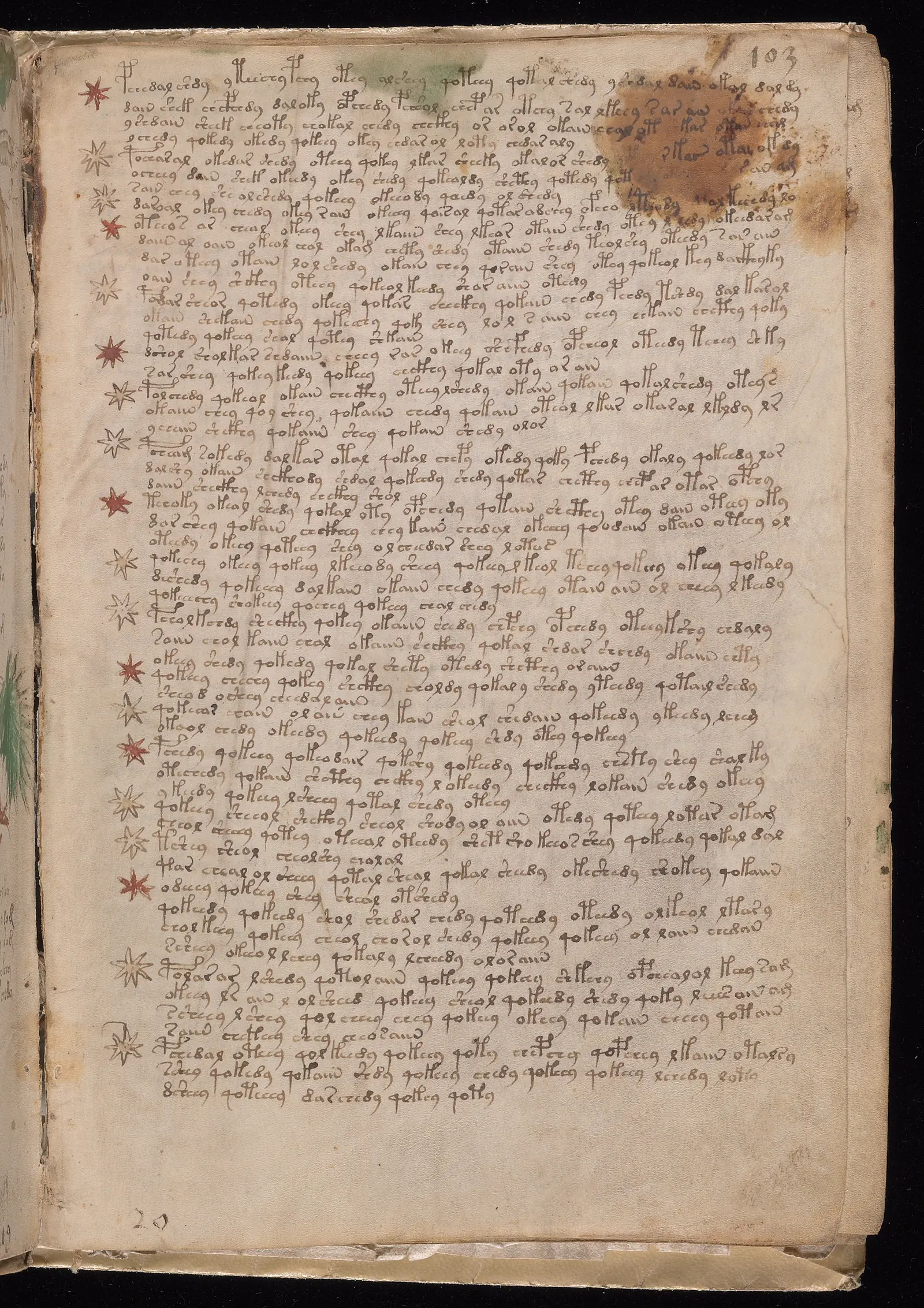
The signature finding: every line is a closed unit.
f103r, lines 9–12. Each arc joins the end of one word to the start of the next: within a line, that link is strong. At every line end it stops.Image: Beinecke Rare Book & Manuscript Library, Yale University, MS 408The book itself
Before any statistics: the physical facts, each from published analyses or our own source checks. They date and describe the object, not its meaning.
Parchment from 1404–1438
Radiocarbon on four leaves (f8, f26, f47, f68). It dates the skins, not the ink. Quires 10–20 were never sampled.
Five scribal hands
By Davis’s count, a judgement she calls subjective. Hand 1 writes the ‘A’ dialect of the script, hands 2–5 write ‘B’. Hand, dialect and section are entangled.
102 of about 116 leaves
18 of 20 quires survive. The leaves were already misordered before the 15th-century quire marks were added.
Iron-gall ink, azurite, ochre
Text and drawing ink are ‘in all probability’ the same. Multispectral imaging of 10 folios found no palimpsest or underwriting.
Almost no corrections
About 1 word-level change in 11,878 words, at the 10th–14th percentile of 73 German manuscripts (corr1).
Who owned it
The earliest secure owner is Jacobus Tepenec (ex libris, 1608–1622). It reached Yale in 1969. The Rudolf II purchase rests on one third-hand source.
Line explorer: every line is a closed unit
In ordinary writing, the end of one word and the start of the next are linked by grammar, sound or habit, and that link does not care where the line breaks. In this manuscript, the link is strong inside a line and almost disappears at every line break.


Tap or hover a gap between two words, or use the buttons under the image.
Choose a gap
–
Inside the line the end of one word shifts the odds of how the next begins. Measured over the whole text, that dependence is 0.082 (B: 0.110).
f103r, lines 10–11 (Currier B, hand 3), with the ZL transliteration in EVA letters. A comma in ZL marks an uncertain space. · Image: Beinecke Rare Book & Manuscript Library, Yale University, MS 408
Other measured line habits: the last gap of a line is squeezed, −0.506 standard deviations, replicated on a fresh half, against −0.00 to −0.13 in real hands (lend1); line-end endings are more varied, not rhymed (xmi2); lists with one entry per line reproduce the stop but not the edge preferences (xmi3). Whether the squeeze is planned or just ‘out of room’ is still undecided.
What the text is
Before ruling anything out you have to describe. These properties held in every test, on both halves of the text separately.
Words are built like a slot machine’s, not like a language’s
A Voynich word looks assembled from optional slots: a front sign, a body, an ending. In morph1 the manuscript sat with word generators on all six registered bars (6/6), next to verbose ciphers on 4/6, abbreviation on 2/4 and proclitic languages on 0/6. 20 of the 22 real texts differ from it on three bars or more. There is no small prefix set like Hebrew’s ו־ ב־ ה־ ל־ מ־ ד־.
Word machine (an illustration, not a decoding)
Pick a front, a body and an ending, or press the button. Many combinations land on real manuscript words, because the manuscript’s vocabulary behaves this way. This toy is our illustration of the idea; the generators in the study (G0, G4) were fitted on the manuscript itself, so ‘a generator writes it’ is a fit, not independent proof.
front
body
ending
Most frequent words in the transliteration
No set phrases, no refrains
Repeated runs in the manuscript are almost all two-word pairs, mostly one letter off. Runs of three or more words are 2.9% / 2.8% of repeats (two halves), against 8.5–68% in eleven real corpora with formulas, psalms and refrains (gk3).
No grammar that carries over
In a real language, word pairs learned from one half of a text help predict the other half: 0.10–0.34. In the manuscript the transfer is 0.0003 / 0.0000. Word order is explained by local habits: a deeper seam between words, pair re-use within about 400 words, and a line-slot habit (gk4).
Repeats are not avoided
Every language tested avoids repeating the same word inside a line. The manuscript does not (ratio 1.010 inside a line, 1.297 on the page; sher1).
Labels are written the same way
87% of the labels next to drawings are a single word. Under a code where each word stands for one letter, spelling a name would need 6–10 words; the labels have 1.17 on average (lab1). The between-word seam is present inside multi-word labels too (z +4.91): the same routine as the running text.
Paragraph openings are not headings
Tests that find headings, subjects or formulas in Macer and other herbals at power 0.85–1.00 find none here. The one-off words of a paragraph’s first line are fresh one-letter variants of body words, at generator level (head1).
What is ruled out
Every instrument was first calibrated on texts where we had planted the answer ourselves. Only when it found the planted answer did we run it on the manuscript. That is what makes ‘not found’ mean something, within the scope that was tested.
The best-known cipher model, in six languages
A Naibbe-type verbose cipher writes each letter as one of several Voynich-looking units, with two keys and about 400–800 units. Our decoder reads such planted texts at 82–99% of letters, and its repeated runs on them agree 82–99% of the time. On the manuscript the runs agree 12.5–37.7%, below even a wrong-language control (34.8%). The bar fixed in advance was 80%.
Naibbe-type verbose cipher, about 400–800 units, two keysExcluded
- What was tested
- Latin, Italian, German, Catalan, Hebrew, Arabic: decode the manuscript and check whether repeated runs agree.
- Power on planted positives
- Each language passed its gate first; plants read at 82–99% of letters.
- Manuscript result
- Agreement 12.5–37.7% against an 80% bar, below a wrong-language control.
- Rounds
- rck5, rck6, rck7, rck8
The same family with a per-word key, or tables over 1,000 unitsRunning
Plain language written letter by letter (proclitic, suffixing, abbreviated)Weakened
- What was tested
- Word-structure bars against 22 real texts including Hebrew, Arabic, Syriac, Latin hands.
- Power on planted positives
- 22 real texts as controls; some families lack certified controls.
- Manuscript result
- Slot generator 6/6, proclitic 0/6.
- Rounds
- morph1
A message steering a slot generator at a low rateUntestable
- What was tested
- 1,800 simulated worlds with and without a hidden message.
- Power on planted positives
- Nothing visible at or below 1 bit per word.
- Manuscript result
- Inconclusive.
- Rounds
- gk1
Set phrases, formulas, refrainsExcluded
- What was tested
- Repeated runs compared with 11 real corpora.
- Power on planted positives
- 42 of 43 control windows identify their own profile.
- Manuscript result
- Runs of 3+ words 2.9% vs 8.5–68%.
- Rounds
- gk3
A grammar of word pairs that carries across the textExcluded
- What was tested
- Pairs learned on one half, tested on the other.
- Power on planted positives
- Real texts transfer 0.10–0.34.
- Manuscript result
- 0.0003 / 0.0000. Longer-range order at language strength unresolved.
- Rounds
- gk4
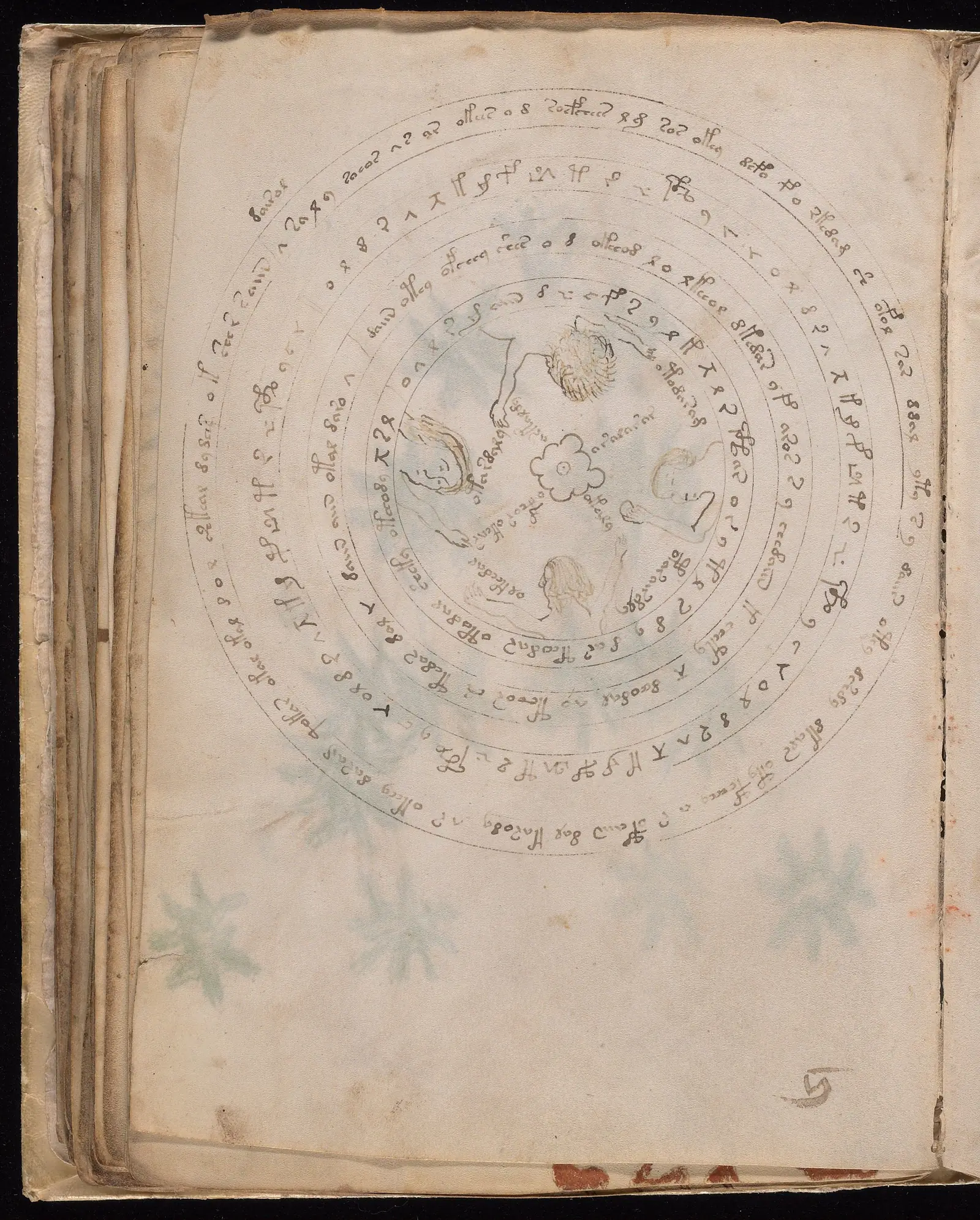
Zodiac labels as day counters, ordinals or dominical lettersExcluded
- What was tested
- Labels on the ring figures against real calendars.
- Power on planted positives
- Real calendars z 7–64; power 1.00.
- Manuscript result
- Highest z +1.42, 0 of 12 cells.
- Rounds
- zod5
Zodiac labels as lunar-mansion namesExcluded
- What was tested
- Label similarity against the mansion sequence.
- Power on planted positives
- Mansions +63.8.
- Manuscript result
- Manuscript +13.4.
- Rounds
- zod5/r2
Zodiac labels as per-day saints’ namesUntestable
Labels as names spelled out, one word per letterExcluded
Paragraph first line as heading, subject or formulaExcluded
The word-to-word seam as a running key or grammarExcluded
A one-letter-per-word code keyed by contextUntestable
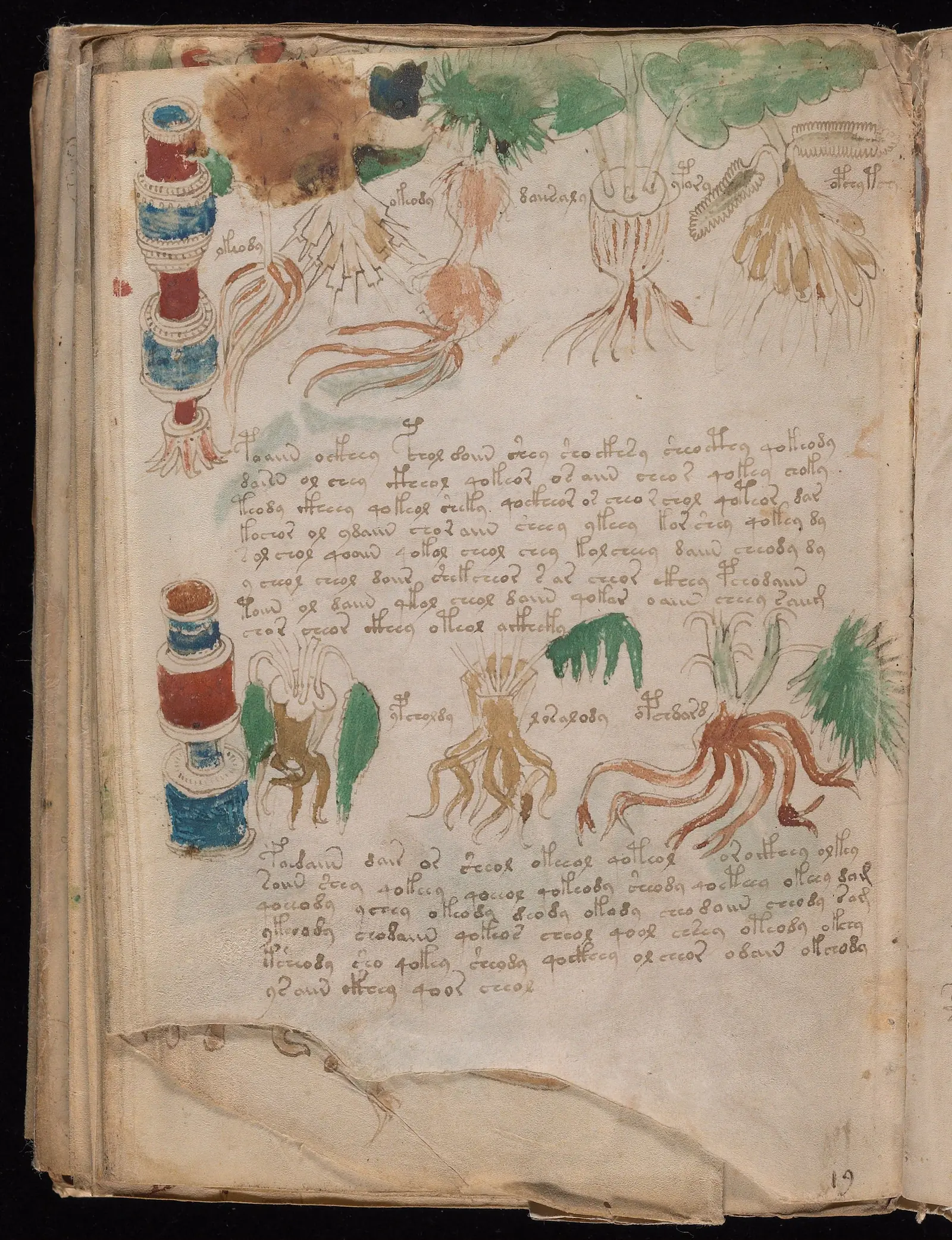
Organ names, numerals or plant names as cribsExcluded
- What was tested
- Bath labels, zodiac labels, herbal openers.
- Power on planted positives
- About 1 at 50% wrong cribs for letter-per-sign; 0.00–0.05 for other ciphers.
- Manuscript result
- 0 of 28 cells pass.
- Rounds
- crib1
Bath drawings as organs (Lia’s reading)Open
Parallel or twin pages (a ‘Rosetta’ inside the book)Excluded
A North-Italian source (Chigi copy)Excluded
Hidden writing under paint (multispectral images)Open
- What was tested
- Vessels and fold of one panel, and the notes on f17r and f116v.
- Power on planted positives
- Planted strokes 10/12 found, false alarms 2/12 (missed its bar).
- Manuscript result
- Only known labels; one possible fuller form under red paint.
- Rounds
- msi1
Gap width as a codeExcluded
Homophones with vowel deletion, low-reuse code book, heavy strippingOpen
No message at all (a word machine or habit)Untestable
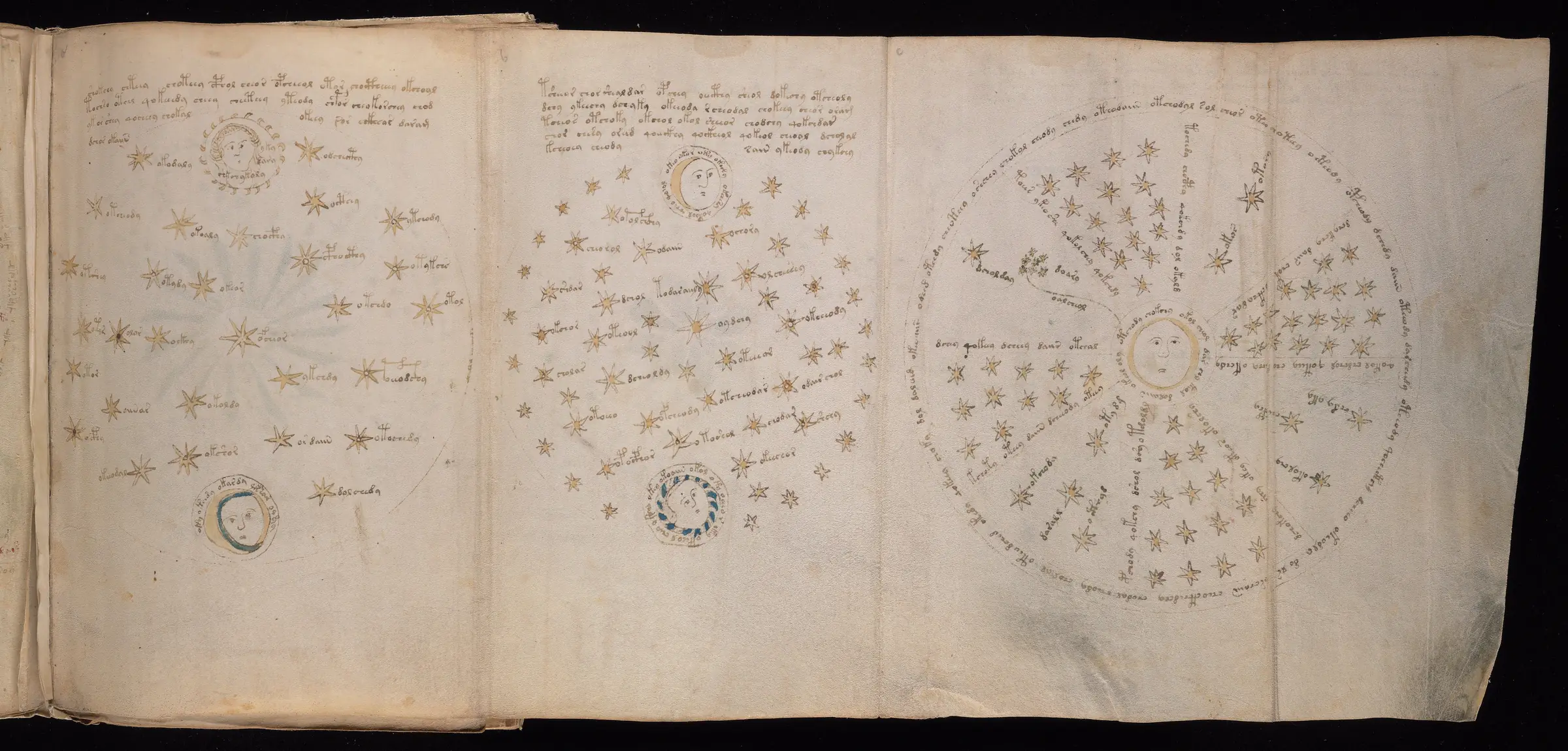
Where does a zodiac ring start?
A per-day saints’ calendar can only be tested if we know which figure is day 1. Known within one figure, the test has power 0.73–1.00; unknown, at most 0.27 (zod5/r4). Multispectral images cover only 2 of the 6+ signs needed, so the question waits for the Beinecke (phys1).
The limit: why statistics alone will not solve it
We built 1,800 simulated worlds: the same word machine, once steered by a hidden message and once without. A sparse message, up to one bit per word, was invisible to every statistic. A key spread over whole words stayed hidden up to 3 bits per word in G0 (gk1). And even with the true key, a word-per-letter code at the manuscript’s size could not be recovered: the ceiling is 0.79–0.84, below the 0.90 needed (code3).
So ‘no message’ and ‘a sparse message hidden in word choice’ produce the same text. Deciding needs something from outside the statistics: a crib (a known word tied to a place), a guessed key rule, or physical evidence of how the text was written.
Pages from the manuscript
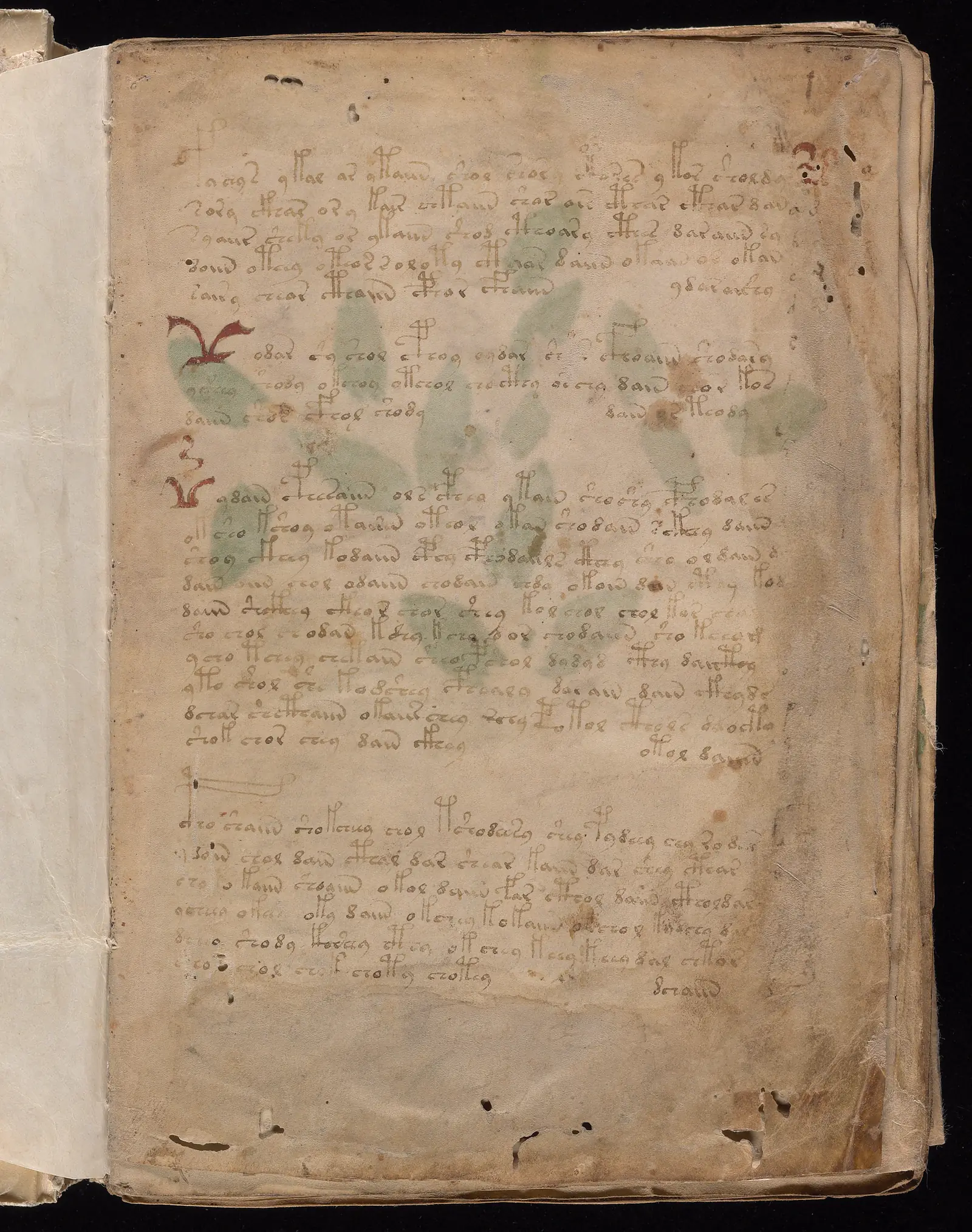
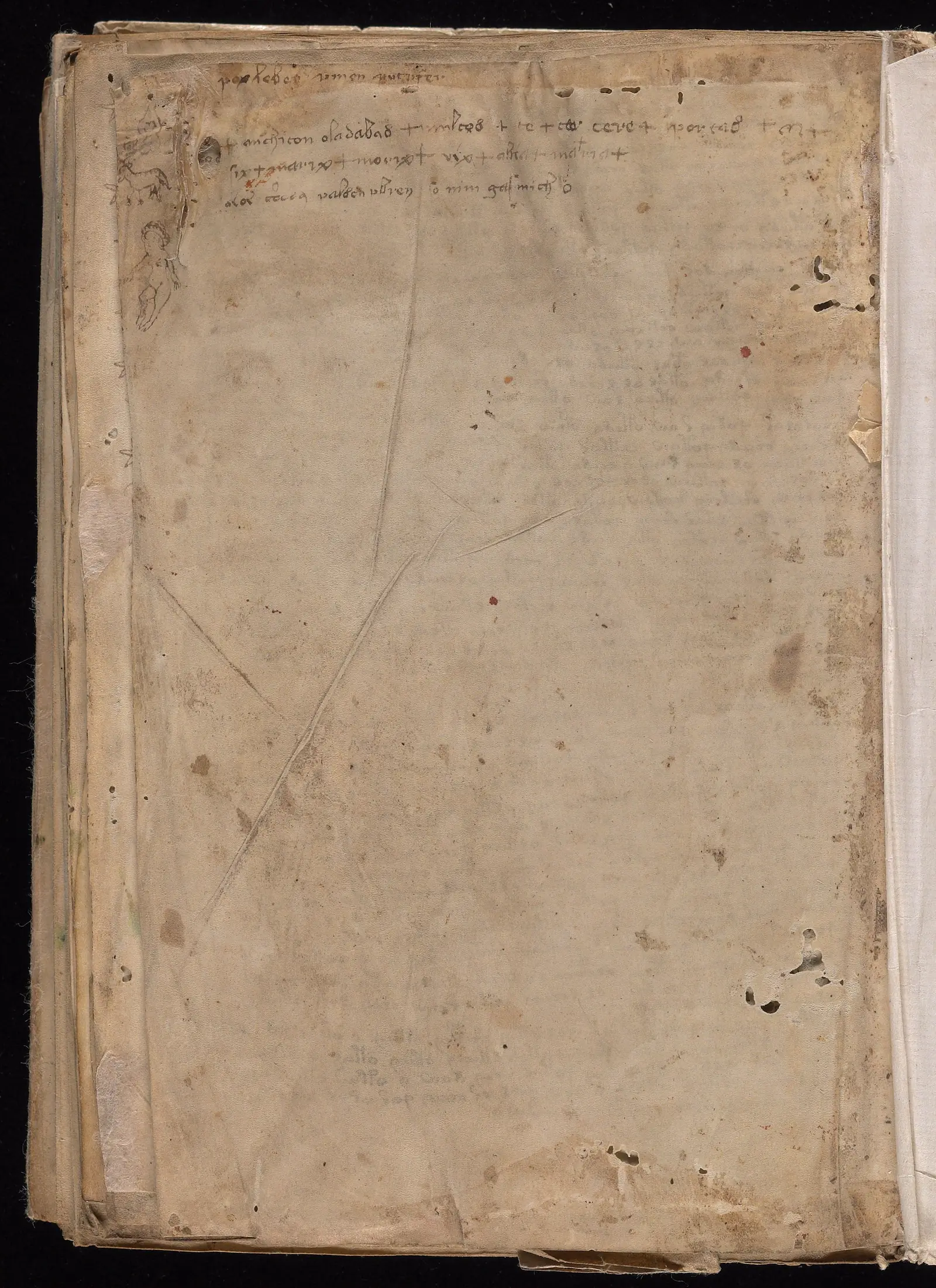
Twelve pages, each tied to a finding. Click a page to open it large.
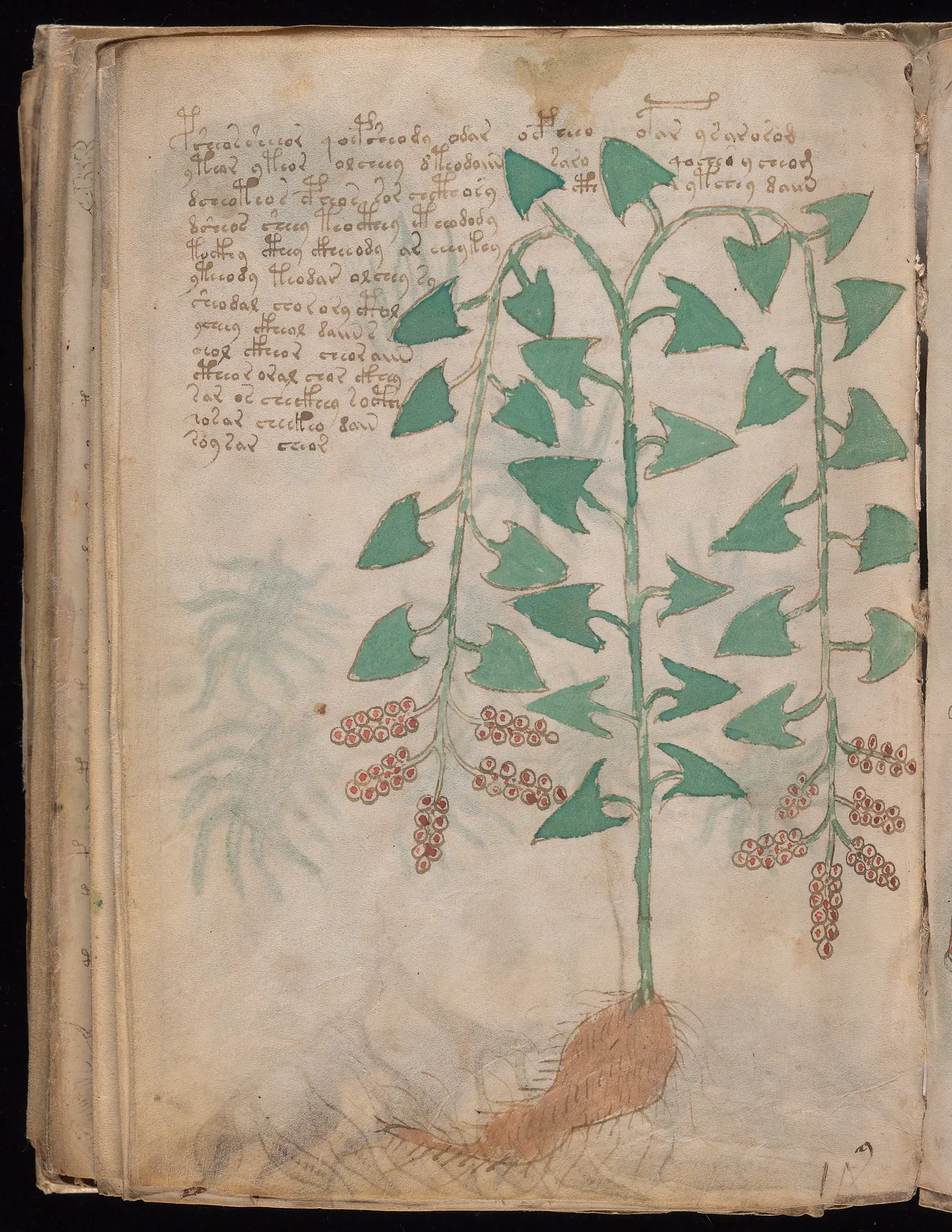
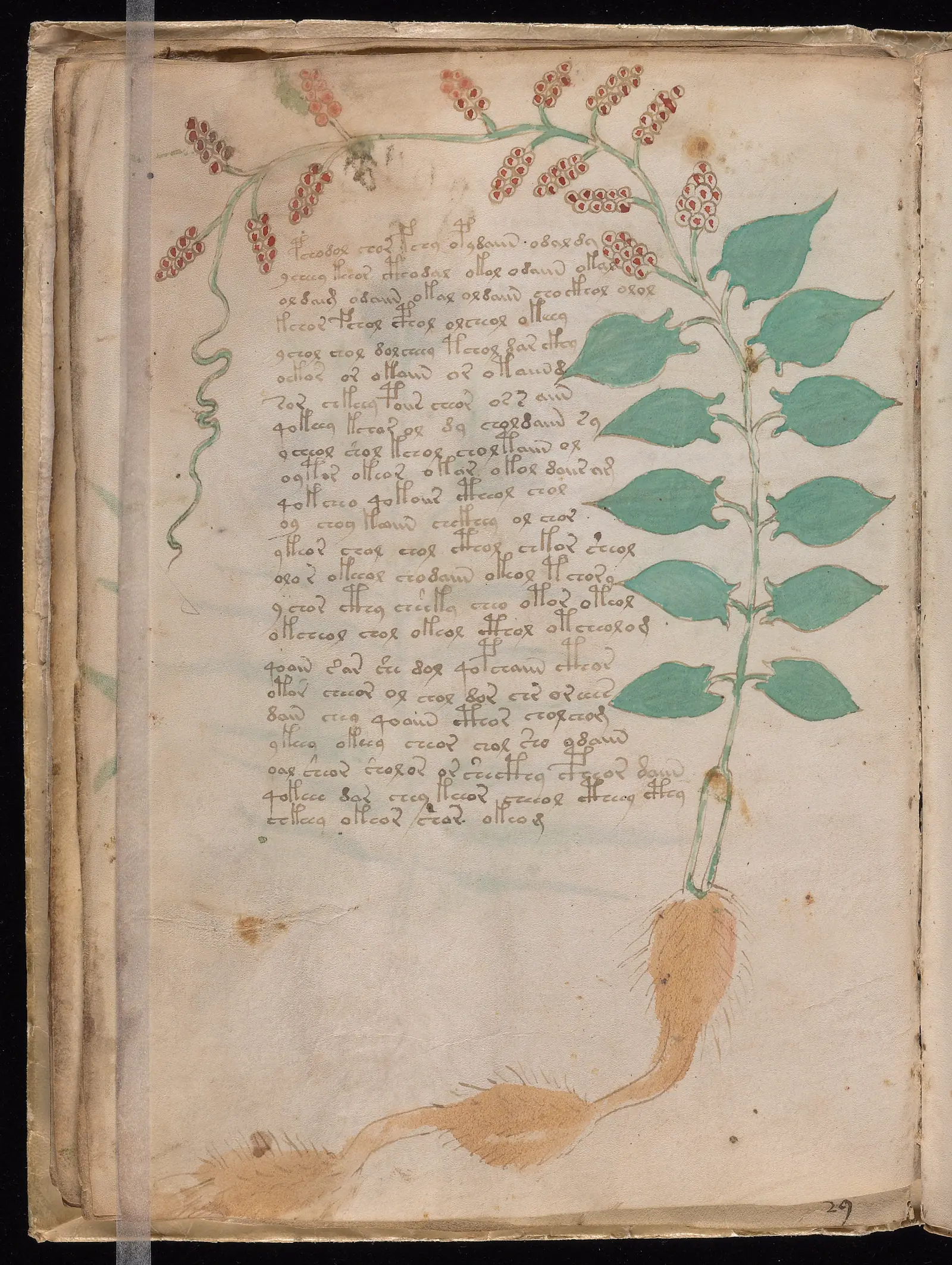
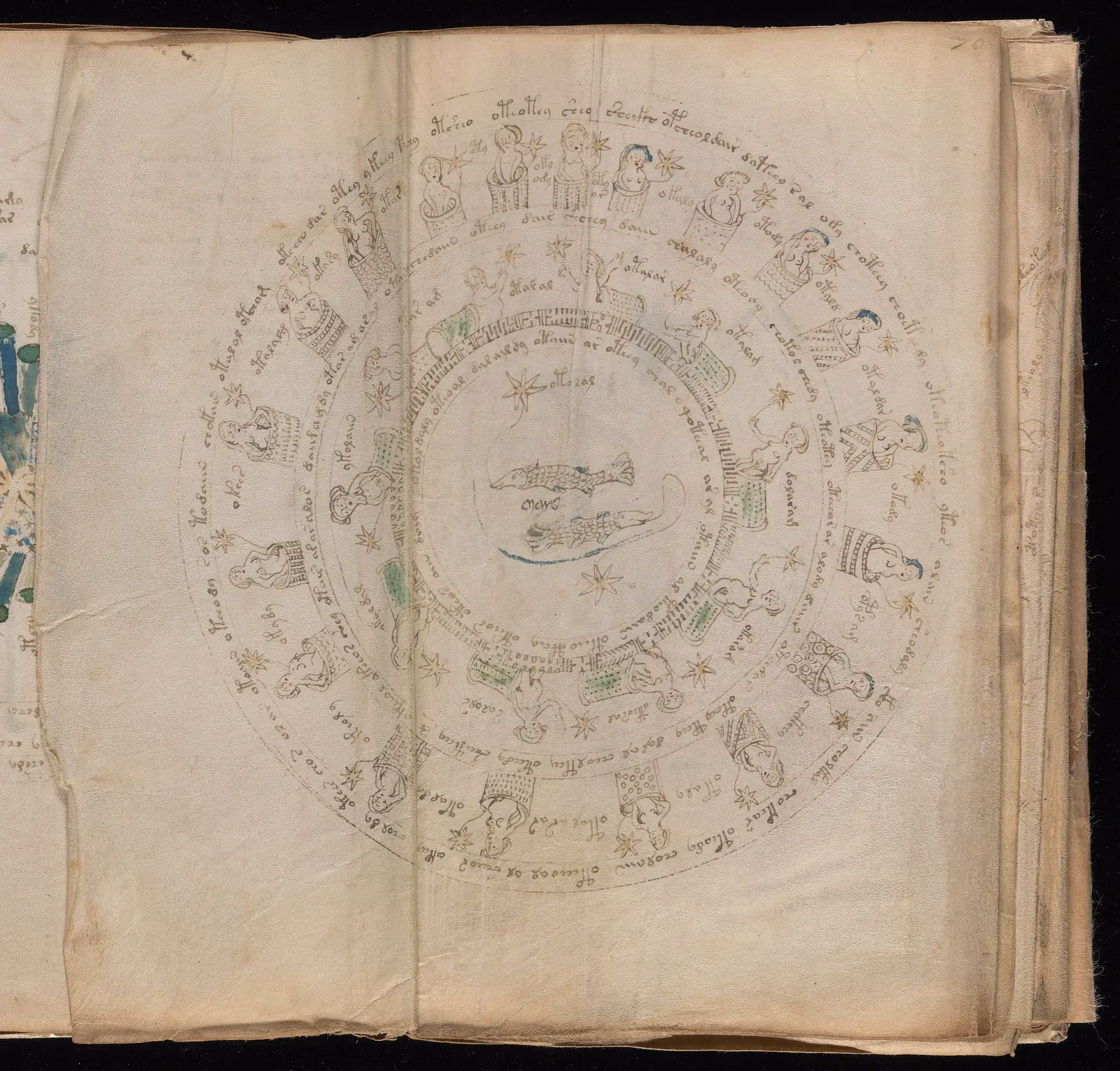
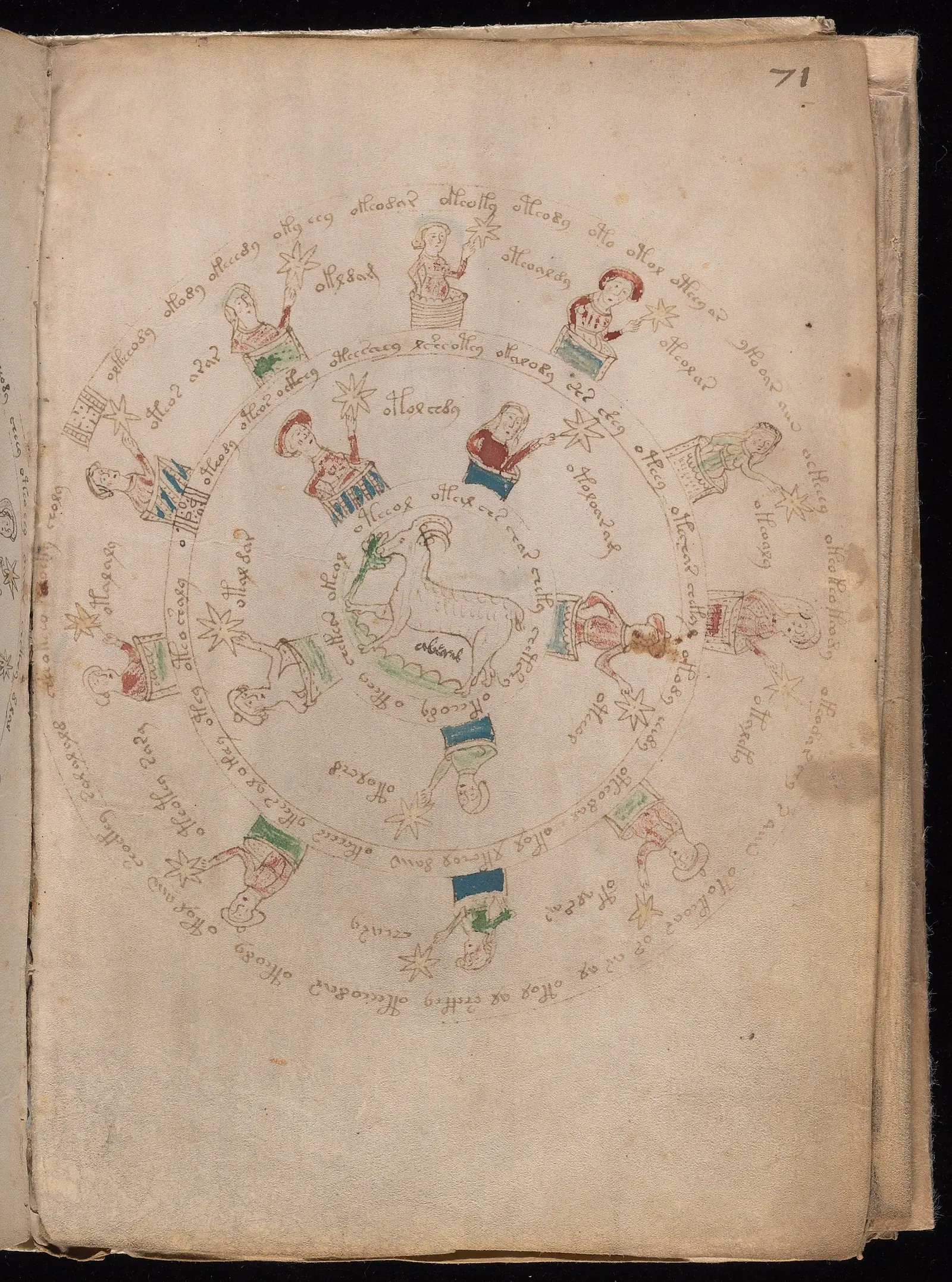
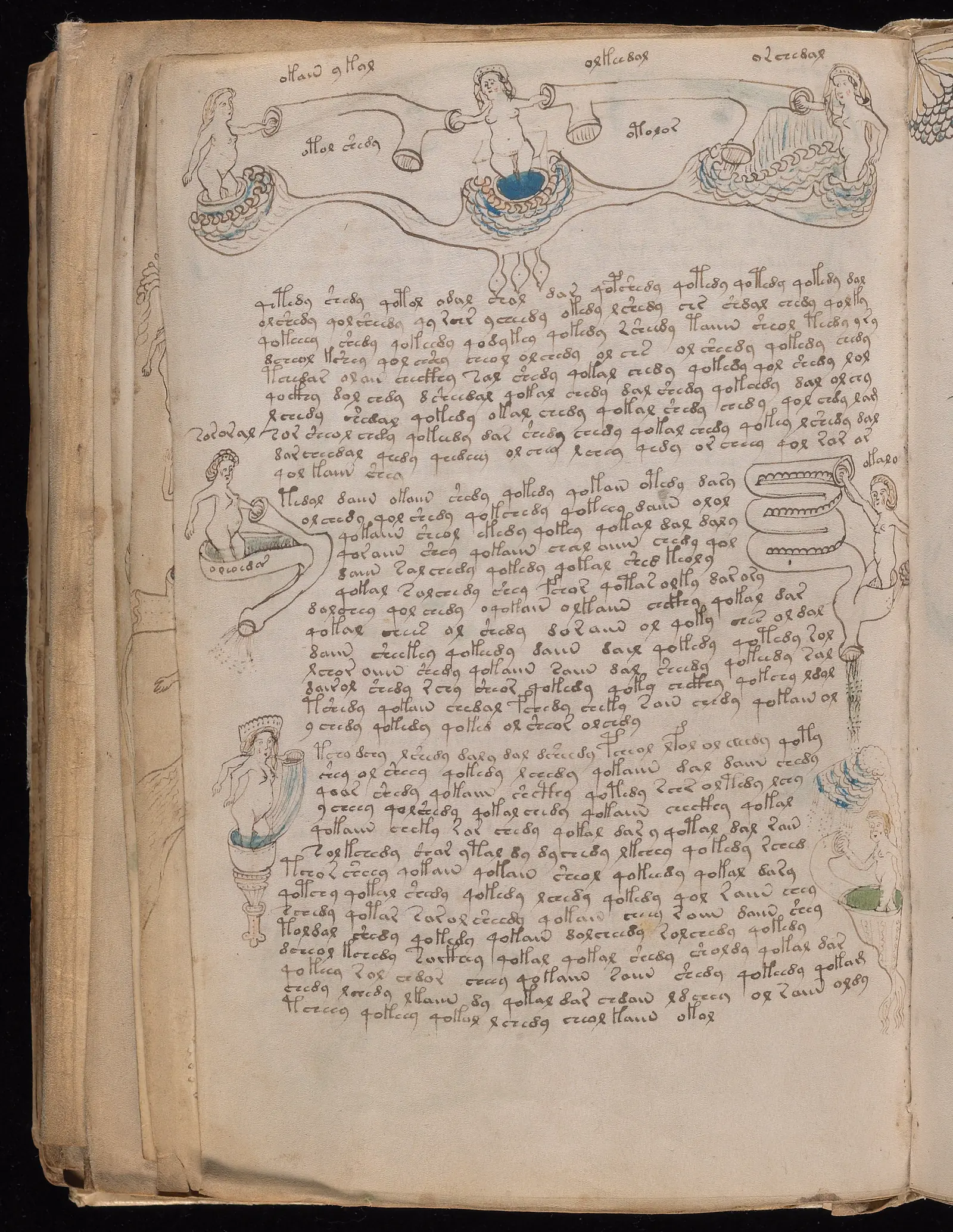
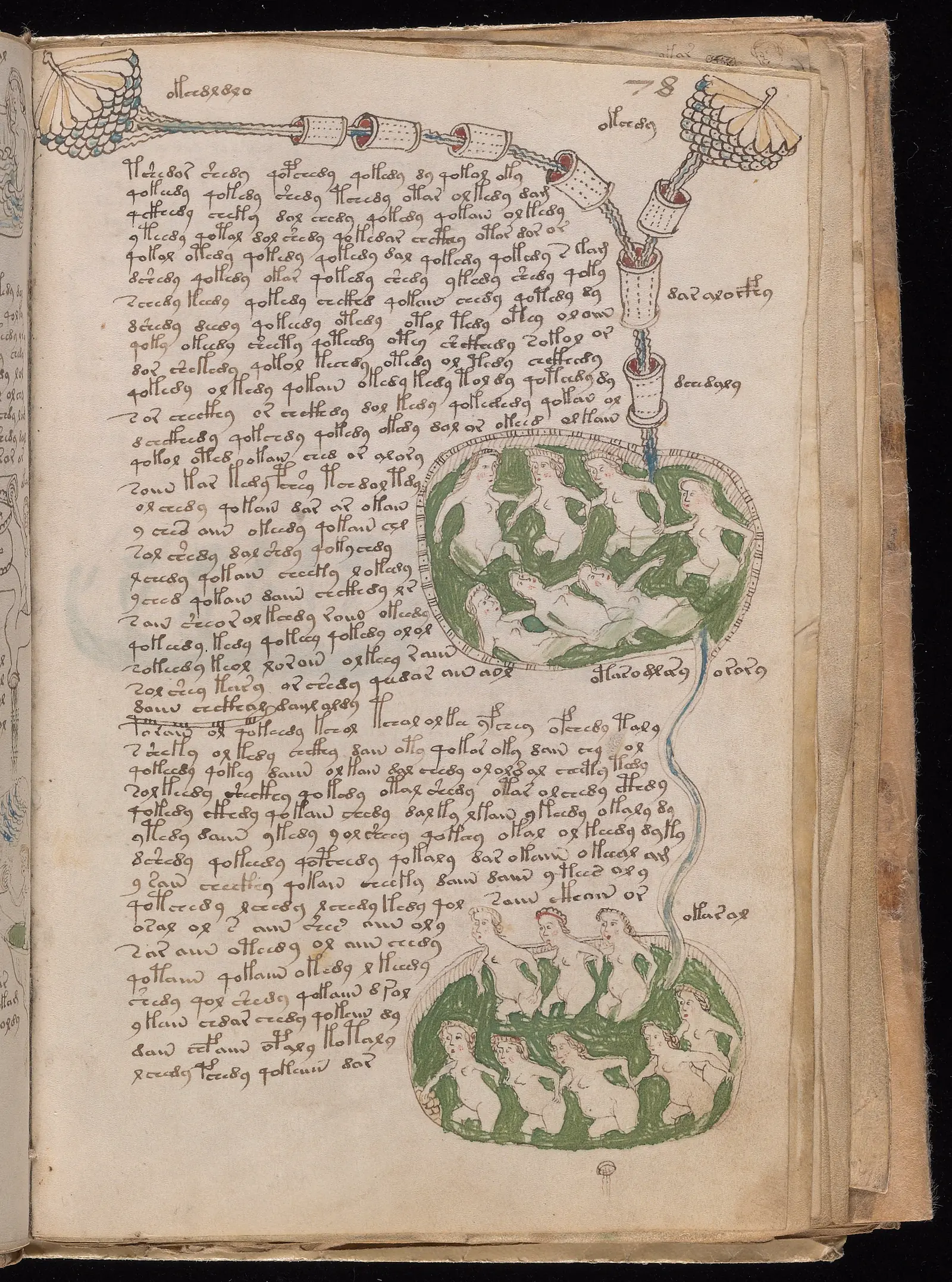


Manuscript images: Beinecke Rare Book & Manuscript Library, Yale University, MS 408 (public domain). Transliteration: ZL (Zandbergen–Landini), EVA alphabet.
How we worked
The rules were designed so that a hopeful result could not slip through.
Pre-registration
Each round wrote its hypothesis, bars and code into a file and sealed it with a sha256 hash before the manuscript run. The record holds 209 such hash files. Where a rule was broken (for example a dev run that printed manuscript values early in gk1), the round says so.
Planted positives
Every instrument first had to find answers we hid ourselves in known texts. No power, no verdict.
Nulls
Shuffled manuscript text, machine-made text with no message, and 22 real texts in many languages.
Two halves
Settings were fitted on one half of the manuscript and tested on the other, unseen half.
A second agent
Each direction got a second, independent check with a different method, blind to the first.
Where we were wrong
25 of our own conclusions were corrected along the way. The most instructive:
- ‘The verbose cipher is the one family still open’ was wrong twice. It was later excluded in six languages (rck5–rck8).
- ‘Sign + word = proclitic-like’ is corrected by morph1: the rate comes from the sign chain itself.
- ‘Timm–Schinner reaches the word-order statistic’ came from our re-implementation; the published generator does not.
- ‘Ordered word runs’ is corrected by gk3: runs carry at most about 12% of the excess; it is diffuse type order.
- The ‘North-Italian / Chigi pull’ was mostly an artefact; corrected it is 55%, p 0.074 (capkey3).
- f96v as a ‘solid anchor’: it is a plant kind, not an identification, and it is Currier A, not B.
Show all 25 corrections
- Round 49’s ‘only the abbreviation family matches’ is retracted: word generators match too (body1). Round 49 had no generator controls.
- ‘The manuscript’s cross-word link is the highest of 9 languages’ was a raw artefact. Matched for alphabet size it is tied at the top with Tongan (spread1).
- fw1’s ‘opening shape = alchemical-herbal family’ is absorbed by a general page-start term; fw2’s own verdict is confounded by section.
- ‘The cipher-chain family is closed’ was overstated. chain1 does not exclude a fitted table or word-triggered relabels.
- ‘Three results point to an alchemical herbal’ were three non-detections from one control text, not positives.
- The ‘12–20% vs 3%’ contrast in figural roots was overstated: the sources were not family members or a census.
- The ‘North-Italian / Chigi pull’ was mostly an artefact; corrected it is 55%, p 0.074 (capkey3).
- f96v as a ‘solid anchor’: it is a plant kind, not an identification, and it is Currier A, not B.
- ‘The verbose cipher is the one family still open’ was wrong twice. It was later excluded in six languages (rck5–rck8).
- ‘At most 5% of words could carry a message’ had no source round; it is unsupported.
- piece3 was stopped without a result: its gate script never ran, and nothing was decoded.
- ‘Paragraph openers = body word + gallows’ is not supported by a certified instrument.
- The ‘page-bottom formula’ hint is closed as layout; its kill test cannot run without held-out herbal-B text.
- The line-position profile ‘replicated’: the matched value depends on sample size.
- lend1’s weaker squeeze on paragraph-last lines is unstable across halves.
- ‘Sign + word = proclitic-like’ is corrected by morph1: the rate comes from the sign chain itself.
- ‘-aiin behaves like a function word’ is corrected: a class-blind anti-repeat writes it.
- mech2’s ‘memorised depth’ rested on a wrong null.
- sher2’s trade-off came from its own construction.
- ‘Timm–Schinner reaches the word-order statistic’ came from our re-implementation; the published generator does not.
- ‘Ordered word runs’ is corrected by gk3: runs carry at most about 12% of the excess; it is diffuse type order.
- rck5 pre-registration defect: one rule was not fully blind. Without it the Latin gate fails 2 of 3.
- code3’s registered ceilings were superseded after a letter-folding mismatch; the verdict is unchanged.
- Month names: a Picard reading was misquoted as corroboration; it is weak.
- audit1 (15/11) downgraded many earlier verdicts in the findings log.
Roadmap
Where the work stands on 17 November 2026.
- done
Map of what is ruled out
291 round result files, six languages for the cipher model, 22 control texts, 25 corrections, a full research record.
- running
gk5: can three no-message habits write the word order?
The G4 word machine plus a pair memory, a deeper seam and a line-slot habit, tested against the manuscript; plus pair direction on a second transliteration.
- running
rck9: the last two verbose-cipher cases
A key chosen per word, and tables of 1,000–3,000 units: first, can any decoder read such plants at the manuscript’s size?
- waiting
Request to the Beinecke Library
Prepared and awaiting sending: ink and imaging data, multispectral images of the zodiac pages (where does each ring start?), ink of the marginal notes, ink per scribe, higher-resolution masters, raking light.
- next
Text rounds without outside data
A registered matched-null round for word structure, a fix to the crib instrument, a census of figural roots, and powered tests for five families with no test since audit2.
- what would decide
What would settle it
A crib tied to a place in the text; a guessed key rule; or physical evidence of process: ink campaigns, corrections, ruling.
Research diary
From 18 November 2026 a nightly run adds one new direction per day. Each entry links to its full result in the record.
The first daily direction will appear here tomorrow.
Questions people ask
Has the Voynich manuscript been deciphered?
No. Nobody has a verified reading, and this project claims none. What we can say is narrower: the best-known verbose-cipher model fails in Latin, Italian, German, Catalan, Hebrew and Arabic; calendar counters and lunar-mansion names in the zodiac fail; headings, set phrases and refrains are absent at the strength tested.
How old is the Voynich manuscript?
Radiocarbon dating of four parchment leaves gives 1404–1438. That dates the animal skins, not the ink, but nothing found so far points to a much later writing.
What does the text look like statistically?
A rule-driven writing system: every line is a closed unit, words are built from optional slots like a generator’s, repeats are not avoided, and there are no transferable word-pair grammars, set phrases or refrains.
Is it a hoax or meaningless?
A no-message word machine is the best fit so far, but it is fitted on the manuscript and no short procedure writes the whole text. A sparse message hidden in word choice cannot be excluded by statistics. Both remain possible.
What could settle it?
Evidence from outside the statistics: a known word tied to a place in the text, a guessed key rule, or physical evidence from the book itself, such as multispectral images of the zodiac rings or ink analysis per scribe.
Can I check the evidence?
Yes. Every number on this page comes from a result file. The full record, every round’s result and pre-registration, and the research maps are free to download below.
Have information to contribute?
Researchers, libraries and anyone with something concrete are welcome to write. Especially:
- images of the manuscript, ink or imaging data
- provenance or archival facts
- known cribs or word meanings
- transcriptions
- counter-evidence to anything on this page
Please include your sources, so it can be checked and credited.
Download the full record
Every number on this page comes from a result file. These are the complete documents, with the evidence for every round.